
Everything in Moderation: Why the Future of Retail Isn’t “More Restaurants,” It’s Better Merchandising
When soft-goods retail migrated online, the retail real estate industry overcorrected.
Developers looked at their empty boxes and said: fill it with restaurants.
For a while, it worked. Restaurants brought life, energy, foot traffic.
But in a lot of projects, the pendulum swung too far. More restaurants than the market could support. Spaces oversized beyond what operators could sustain. An assumption that hospitality could carry an entire merchandising plan on its own.
Now the consequences are showing up: closures, turnover, empty dining rooms in places that were never meant to be food-only ecosystems.
There should be balance. Even restaurants.
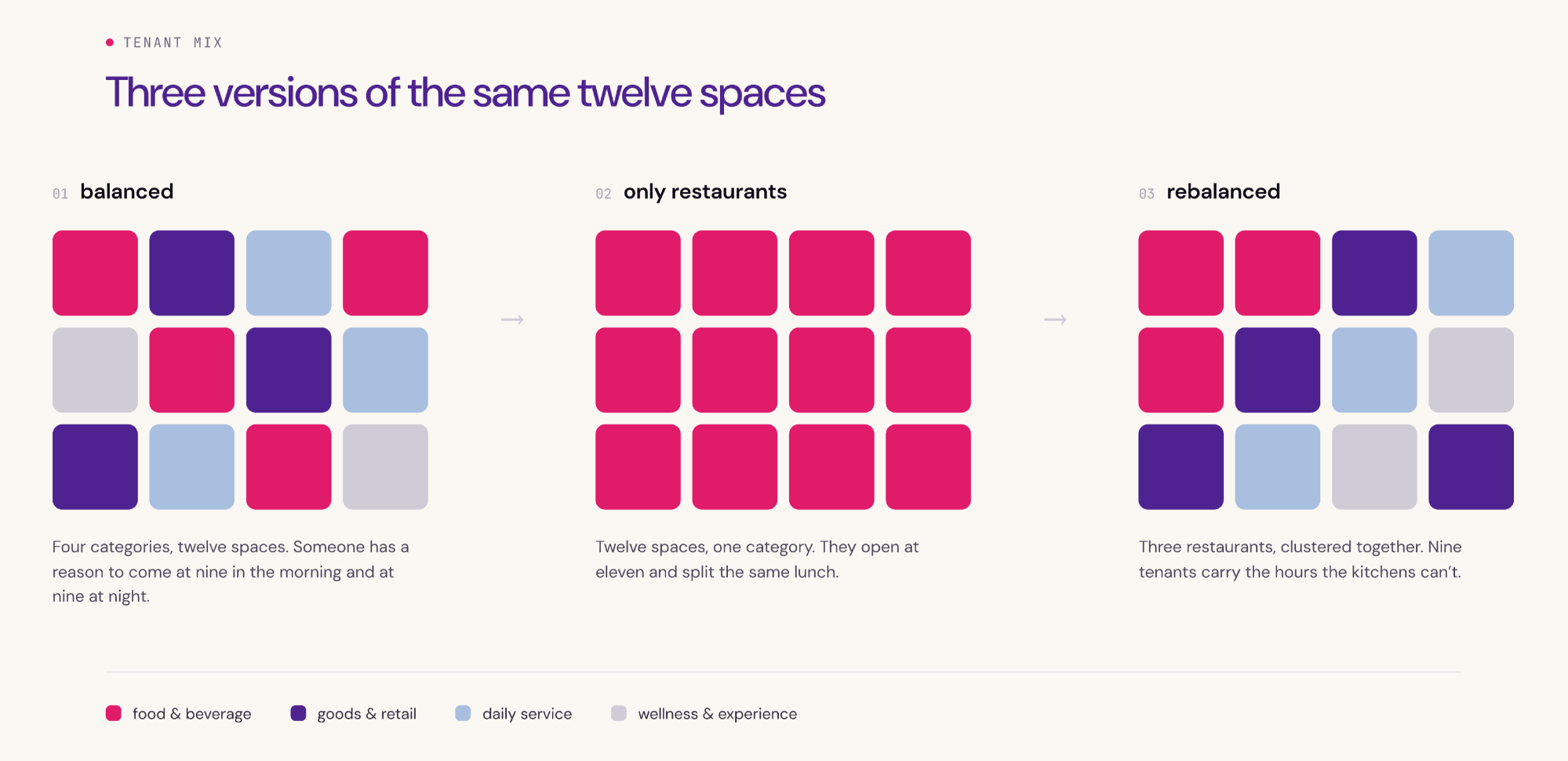
What communities actually need is variety
People don’t want a monoculture. They want texture. Options. Variety. Places that feel like them and an opportunity to EXPLORE.
A main street or retail village works when the mix is intentional and balanced: food and beverage, services, makers, specialty retail, coffee and community hubs, wellness, creative uses, everyday essentials - even opportunities to make.
Every community has its own version of that mix. No two markets look identical — which is exactly the point.
Take for example, Pigment, a home goods and plant shop at One Paseo in Del Mar.
It sells houseplants, succulents, cacti, planters, furniture, stationery, kids' books. Good merchandising, nice fixtures, the kind of store that photographs well.
That's not the interesting part.
The interesting part is that Pigment also teaches you how to plant the thing you just bought. There's a terrarium bar. There are in-store workshops. There's story time for kids. You can book a private workshop for a group.
Which means Pigment is not really in the business of selling plants.
It's in the business of giving people a reason to come back on a Saturday when they weren't planning to buy anything.

Smaller spaces succeed more often
When restaurants get oversized, they struggle. When retail bays get oversized, tenants fail before they have a chance to grow.
Right-sizing space, especially for emerging brands, is the most underrated strategy in real estate today.
The Barnes & Noble example is even better than the premise. They didn't just shrink, they decentralized. Store managers now pick their own inventory based on what their neighborhood reads, instead of taking a planogram from headquarters. Old rule was every store 25,000–28,000 SF, laid out identically. New stores run 5,000 to 35,000. About 60 opened last year, 60 more coming in 2026.
So the chain that killed independent bookstores is now surviving by acting like one.
Smaller spaces mean lower overhead, faster buildout, lower risk, more variety, stronger streetscapes, and higher survival rates in years one through three.
Want a thriving district? Don’t build one giant restaurant. Build five thoughtfully sized ones and weave them into a larger ecosystem of uses.
Moderation and intentionality
The next era of retail real estate won’t be defined by how many restaurants fit on a site. It will be defined by:
smarter studies
right-sized spaces
curated variety
human-scale design
community-first thinking
and a merchandise plan grounded in both data and heart.
Restaurants will always be a critical piece: the soul, the aroma, the energy. They can’t be the entire strategy.
Communities deserve more.
Consumers want more.
The developers who succeed from here will build with balance, not just volume.
Everything in moderation. Especially when the goal is creating places people love.
Merchandising should never start with leasing
It should start with listening.
Before we bring anyone to the table, we run a full market study: trade area diagnostics, spending power and lifestyle profiles, competitive analysis, consumer behavior, leakage and surplus, and on-the-ground interviews.
We study what the community wants, not what will fill space. Successful retail isn’t about forcing a national trend onto a local neighborhood.
It’s about building a mix that reflects the people who live there.